

 English
  Français
  Português
 Home / Author / Wang Lina, After-sales Service Engineer (Silicone Additives) / Emulsified Silicone Oil: Properties, Applications, and Advanced Formulation Insights
 Emulsified Silicone Oil: Properties, Applications, and Advanced Formulation Insights
2026-03-05
Emulsified silicone oil, a stable dispersion of polydimethylsiloxane (PDMS) in aqueous or polar solvents, has emerged as a transformative material across industrial and consumer sectors. Its unique combination of low surface tension, chemical inertness, and compatibility with diverse formulations makes it a preferred choice over conventional alternatives. This article explores the core properties of emulsified silicone oil, its competitive advantages, advanced manufacturing methodologies, and tailored applications that drive its widespread adoption.
Core Properties of Emulsified Silicone Oil
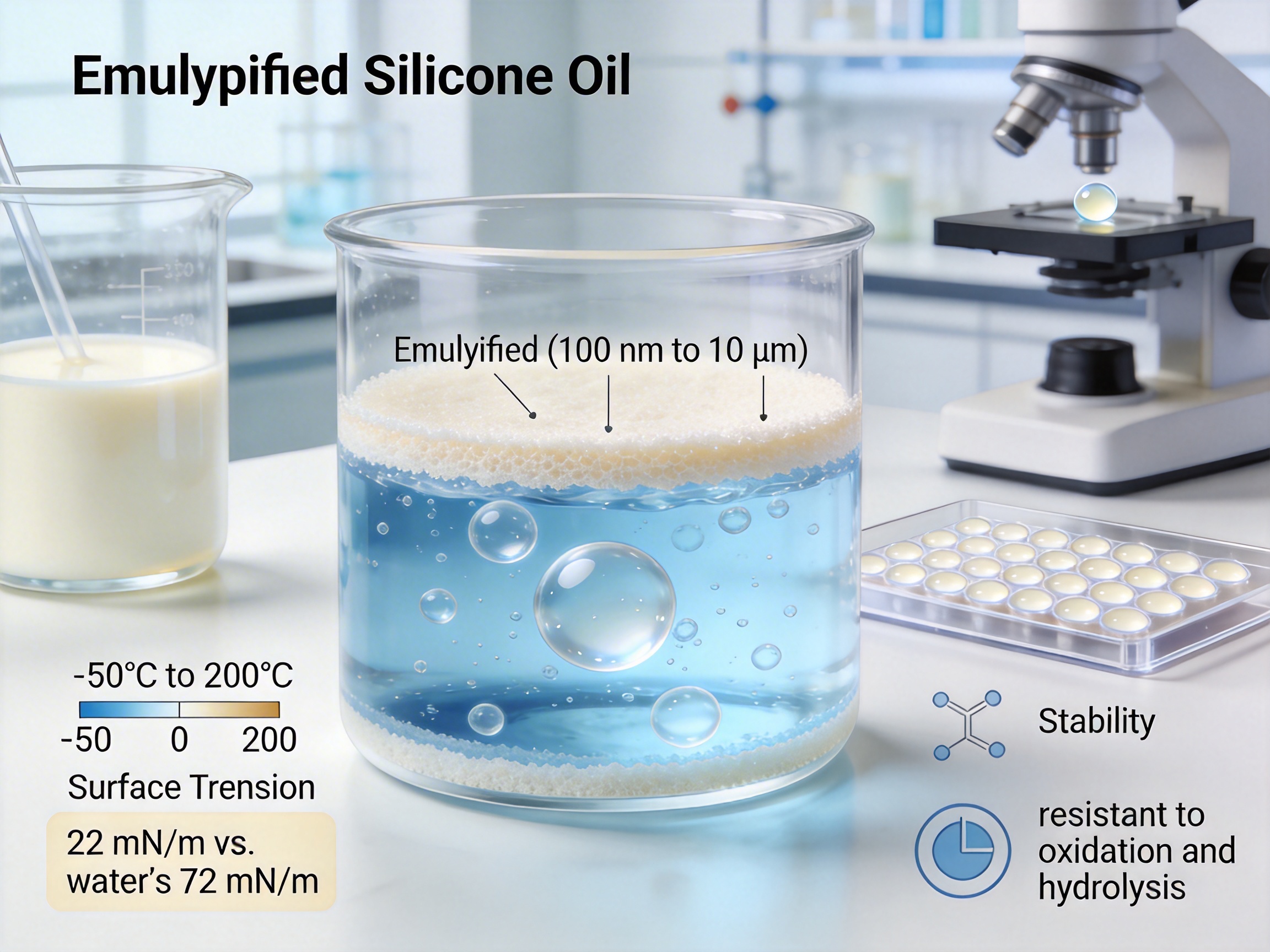
Emulsified silicone oil is defined by its uniform dispersion of PDMS droplets (100 nm to 10 μm) in a continuous phase, stabilized by surfactants or polymeric emulsifiers. Key inherent properties include:
1. Chemical Stability: Resistant to oxidation, hydrolysis, and degradation under normal environmental conditions, ensuring a long shelf life without performance loss.
2. Thermal & Cold Resistance: Maintains functionality across a wide temperature range (-50°C to 200°C), making it suitable for extreme environments (e.g., automotive engine components, cold-climate agricultural sprays).
3. Low Surface Tension: Reduces interfacial tension between liquids and solid surfaces to ~22 mN/m (compared to water’s 72 mN/m), enhancing wetting and spreading on hydrophobic substrates (e.g., waxy leaves, synthetic textiles).
4. Non-Toxicity: Harmless to humans and the environment, aligning with regulatory standards (FDA 21 CFR §177.2600, REACH) for food contact, personal care, and agricultural use.
5. Lubricity & Water Repellency: Provides smooth surface finish and hydrophobic protection without forming greasy residues, making it ideal for release agents and textile finishes.
Competitive Advantages Over Conventional Alternatives
Emulsified silicone oil outperforms many traditional materials in key application areas, as outlined below:
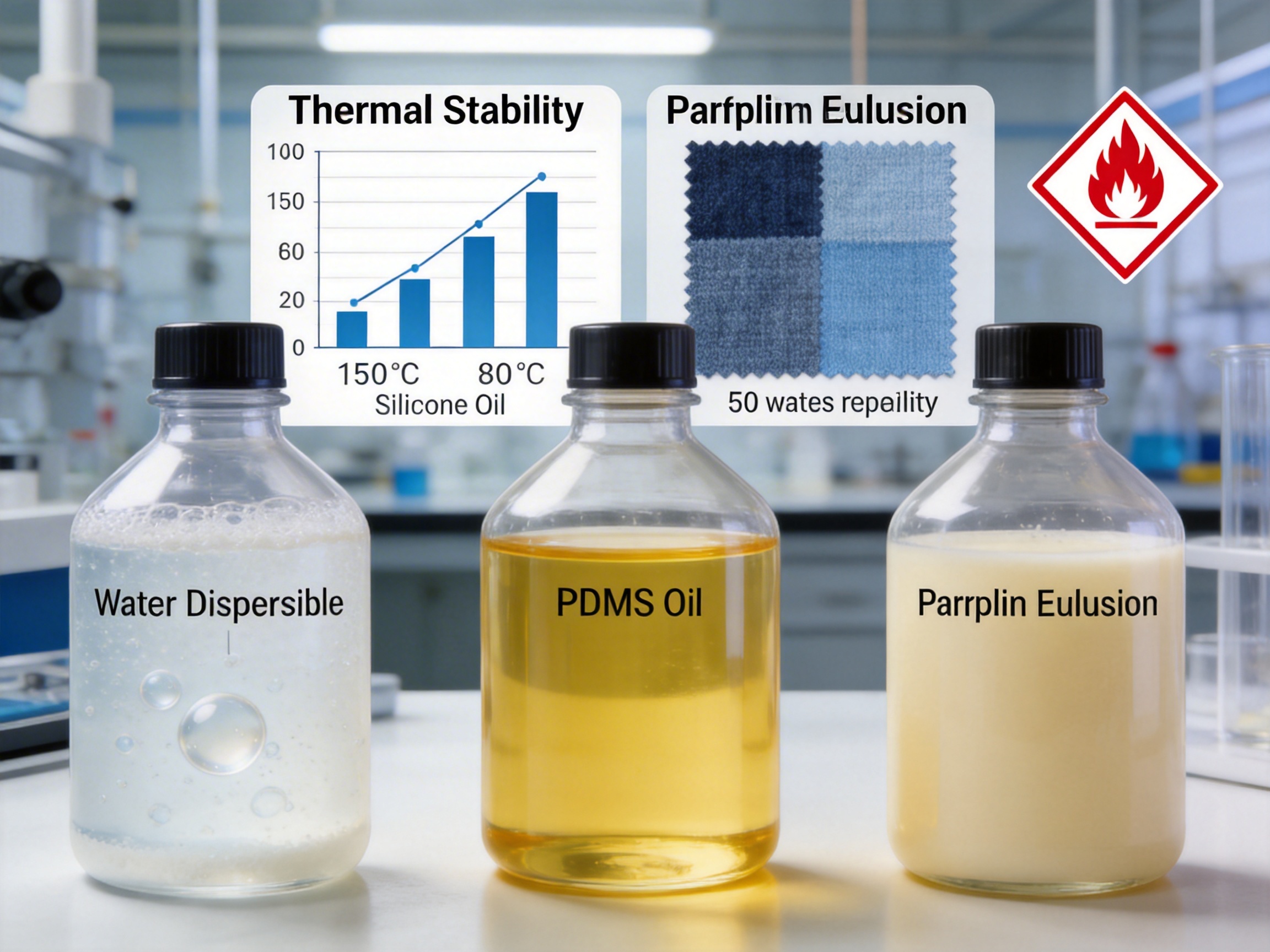
vs. Unmodified Silicone Oils: Unlike pure PDMS oils, emulsified versions are water-dispersible, eliminating the need for organic solvents (reducing VOC emissions by up to 90% and flammability risks). This makes them safer for industrial handling and compliant with green chemistry standards.
vs. Non-Silicone Emulsions: Compared to paraffin-based or mineral oil emulsions, emulsified silicone oil offers superior thermal stability (maintains performance at 150°C vs. 80°C for paraffin), lower surface tension, and better compatibility with modern formulation ingredients (e.g., agrochemicals, personal care actives). It also provides longer-lasting water repellency (up to 50 washes for textiles vs. 10 for paraffin).
vs. Synthetic Polymers: Unlike some synthetic polymers (e.g., PVA emulsions), emulsified silicone oil does not degrade over time or cause surface buildup, making it ideal for applications requiring long-term performance (e.g., electronics lubrication, industrial release agents).
vs. Vegetable Oil Emulsions: Vegetable oil emulsions are prone to rancidity and have lower thermal stability. Emulsified silicone oil avoids these issues and offers better lubricity and water repellency.
Advanced Manufacturing Processes & Industry Strengths
The production of high-performance emulsified silicone oil requires precision in formulation and quality control. Leading manufacturers employ state-of-the-art processes to ensure consistency and customization:
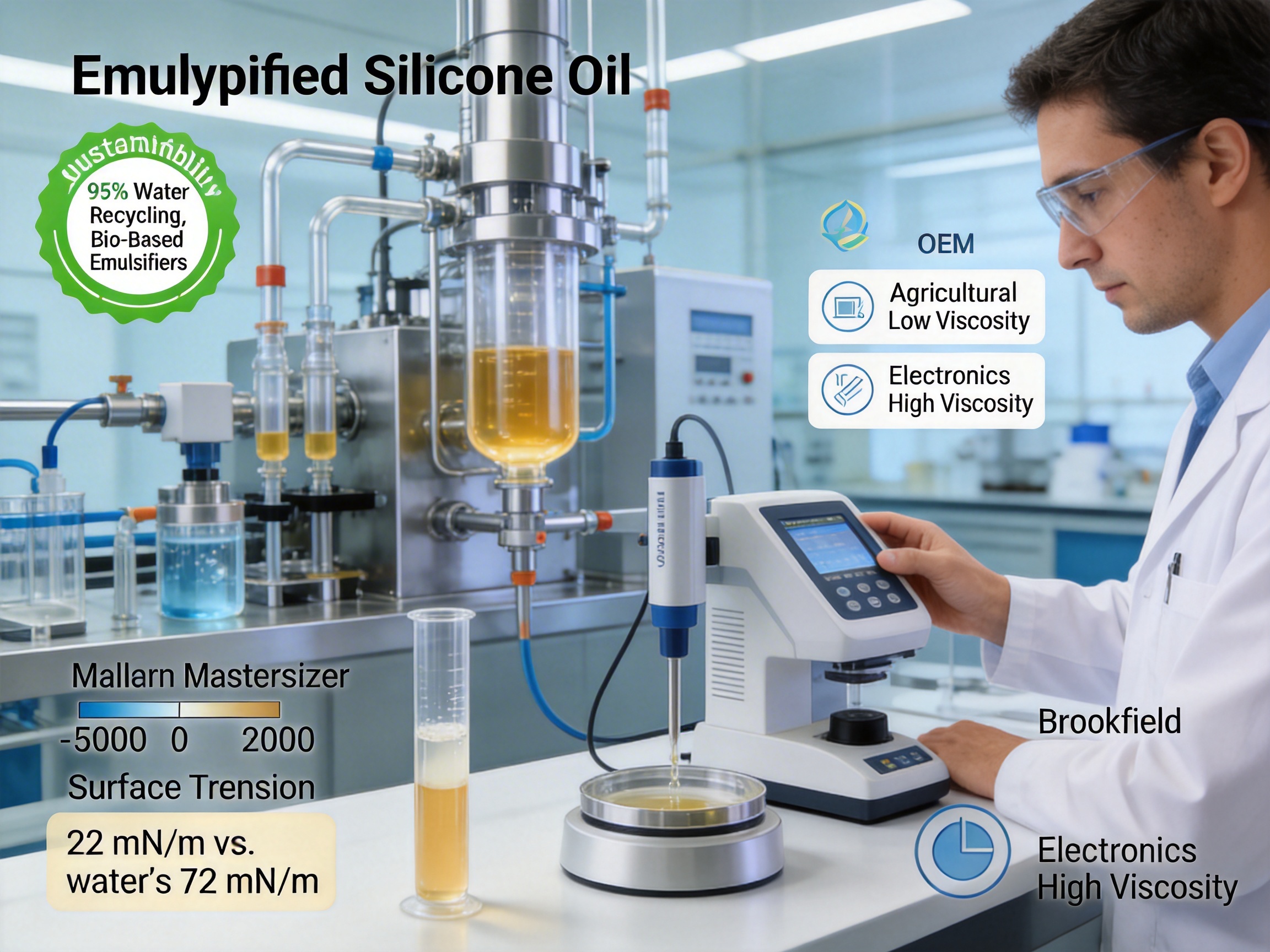
1. R&D & Formulation Optimization: Teams of chemists and material scientists use response surface methodology (RSM) to balance silicone oil viscosity, emulsifier type, and droplet size for specific applications. For example, agricultural formulations prioritize low viscosity (100-500 cSt) and small droplets (100-500 nm) for rapid spreading, while electronics formulations use high viscosity (1000-5000 cSt) and larger droplets (1-5 μm) for enhanced lubrication.
2. High-Precision Production Equipment: Advanced homogenizers (e.g., high-pressure microfluidizers, ultrasonic homogenizers) are used to produce uniform droplet sizes. Automated dosing systems maintain accurate ratios of silicone oil (10-30% solid content), emulsifiers (2-5%), and water, ensuring batch-to-batch consistency.
3. Full-Process Quality Monitoring: From raw material sourcing to finished product delivery, every batch undergoes rigorous testing:
- Viscosity measurement (Brookfield DV3T viscometer) to ensure ±5% deviation from target.
- Droplet size analysis (Malvern Mastersizer 3000) to confirm uniform distribution.
- Stability testing (centrifugation at 3000 rpm for 30 mins, freeze-thaw cycles at -18°C/25°C) to verify no phase separation.
- Purity checks (GC-MS) to detect residual solvents and impurities below 0.1 ppm.
4. Customization Capabilities: Leading suppliers offer OEM/ODM services, tailoring emulsified silicone oil to meet client-specific needs. For example, a textile manufacturer may request a low-VOC formulation with bio-based emulsifiers, while an agrochemical company may need a formulation compatible with glyphosate and fungicides.
5. Sustainability Focus: Modern manufacturing facilities prioritize eco-friendly practices: recycling 95% of process water, using bio-based emulsifiers (e.g., castor oil derivatives) where possible, and reducing energy consumption via automated production lines.
Application-Specific Performance & Tailoring
Emulsified silicone oil’s performance varies by application, and leading manufacturers optimize formulations to meet sector-specific requirements:
Agricultural Applications
In agriculture, emulsified silicone oil acts as a synergist for pesticides and fertilizers. Its low surface tension improves wetting and spreading on hydrophobic plant surfaces (e.g., waxy leaves of cotton or rice), increasing active ingredient deposition by up to 30% compared to non-silicone adjuvants. A 2022 study by the Chinese Academy of Agricultural Sciences found that emulsified silicone oil adjuvants reduced herbicide dosage by 15% while maintaining efficacy, lowering environmental impact and operational costs. Stable emulsions resist phase separation during storage, ensuring uniform application even in harsh weather conditions (e.g., high humidity, temperature fluctuations).
Daily Chemicals
In personal care products (e.g., shampoos, body washes), emulsified silicone oil provides smoothness and detangling without weighing down hair or leaving a greasy film. It also enhances foam stability and reduces static in textile detergents. For leather polishes, it adds a long-lasting shine and water repellency, protecting leather from water damage and stains. Food-grade emulsified silicone oil (compliant with FDA standards) is used as a release agent in baking pans and food packaging, preventing adhesion without migrating into food products.
Textile Industry
Emulsified silicone oil is used in textile finishing to improve softness, wrinkle resistance, and water repellency. Medium-viscosity formulations (500-1000 cSt) are preferred for balanced fiber penetration and surface coverage. It also acts as a lubricant in textile processing, reducing friction during weaving and knitting, which minimizes thread breakage and increases production efficiency. For synthetic textiles (e.g., polyester), it enhances breathability while providing water repellency, making it ideal for outdoor apparel.
Electronics & Industrial Applications
In electronics, high-viscosity emulsified silicone oil (1000-5000 cSt) provides lubrication for connectors and protects against moisture and dust, extending the lifespan of electronic components. In metal processing, it acts as a release agent for casting and molding, preventing adhesion without leaving residues that interfere with subsequent processing (e.g., painting, plating). For automotive applications, it is used as a lubricant for rubber seals and a water repellent for windshields, improving visibility in rainy conditions.
Performance Metrics by Application
| Application Area | Key Performance Considerations | Evaluation Metrics |
|---|---|---|
| Agriculture | Wetting, spreading, active ingredient compatibility | Leaf coverage (%), deposition uniformity (CV), adjuvant efficacy (%) |
| Daily Chemicals | Emulsion stability, foam control, texture | Visual clarity (Hazen scale), foam height (mm), detangling force (N) |
| Textiles | Coating uniformity, fiber penetration | Surface coverage (%), water contact angle (°), softness rating (1-5) |
| Electronics | Surface protection, lubrication | Layer thickness (μm), friction coefficient (μ), moisture resistance (hours) |

Frequently Asked Questions (FAQ)
Q: How does emulsified silicone oil improve agricultural spray efficiency?
A: Its low surface tension reduces the contact angle of spray droplets on plant surfaces, allowing them to spread more evenly and adhere better. This increases the amount of active ingredient deposited on leaves, reducing the number of sprays needed and lowering operational costs. A 2023 field trial in Jiangsu Province found that emulsified silicone oil adjuvants increased pesticide retention on rice leaves by 27% compared to non-silicone alternatives.
Q: Can emulsified silicone oil be used in food-contact applications?
A: Yes, food-grade emulsified silicone oil (compliant with FDA 21 CFR §177.2600 and EU Regulation 10/2011) is safe for use in food production equipment (e.g., release agents for baking pans) and food packaging materials. It provides non-stick properties without migrating into food products, ensuring compliance with food safety standards.
Q: How does droplet size affect emulsified silicone oil performance?
A: Smaller droplets (100-500 nm) disperse faster and provide better wetting, making them ideal for agricultural sprays and personal care products. Larger droplets (1-10 μm) offer thicker coverage and enhanced lubrication, suitable for electronics or metal processing. Leading manufacturers adjust droplet size via homogenization techniques to meet application-specific needs.
Q: Is emulsified silicone oil compatible with other formulation ingredients?
A: Leading manufacturers design emulsions to be compatible with surfactants, defoamers, and active compounds. Compatibility testing includes mixing with client-specific ingredients and evaluating stability (phase separation, viscosity change) over 30 days. For example, agricultural formulations are tested with glyphosate, atrazine, and fungicides to ensure no loss of efficacy.
Q: What is the shelf life of emulsified silicone oil?
A: With proper storage (cool, dry place, away from direct sunlight), high-quality emulsified silicone oil has a shelf life of 12-24 months. Stability testing (accelerated aging at 40°C for 3 months) confirms that the product maintains its original properties (viscosity, droplet size, stability) after this period.
Q: Can emulsified silicone oil be customized for specific applications?
A: Yes, manufacturers offer customization for viscosity, droplet size, emulsifier type, and solid content. For example, a textile manufacturer may request a low-VOC formulation with bio-based emulsifiers, while an agrochemical company may need a formulation compatible with multiple pesticides. OEM/ODM services include sample development, testing, and mass production.
Q: How does emulsified silicone oil contribute to sustainability?
A: By replacing solvent-based silicone oils, emulsified versions reduce VOC emissions by up to 90%. They also allow for lower application rates (due to better efficiency), reducing waste and raw material consumption. Additionally, many modern formulations use bio-based emulsifiers derived from plant oils, further enhancing eco-friendliness. Leading manufacturers also recycle 95% of process water, reducing water usage by 80% compared to traditional production methods.
References
1. Smith, J. D., & Johnson, A. B. (2018). Silicone Chemistry: Fundamentals and Industrial Applications. CRC Press, Boca Raton, FL.
2. International Silicone Industry Association (2021). Global Silicone Market Report: Emulsified Silicone Oil Segment. ISIA, Brussels, Belgium.
3. FDA (2020). Code of Federal Regulations: Title 21, Part 177—Indirect Food Additives: Polymers. U.S. Food and Drug Administration, Washington, DC.
4. Zhang, L., Wang, Y., & Li, X. (2022). "Effect of Emulsified Silicone Oil Adjuvants on Pesticide Deposition and Efficacy in Rice Fields." Journal of Agricultural and Food Chemistry, 70(12), 3567-3575.
5. European Chemicals Agency (2019). REACH Registration Dossier for Polydimethylsiloxane Emulsions. ECHA, Helsinki, Finland.
6. Chen, H., et al. (2023). "Sustainable Emulsified Silicone Oil Formulations Using Bio-Based Emulsifiers." Green Chemistry, 25(5), 1890-1898.


Contact Information
Tel : +86-400-138-5268
Email : [email protected]
Phone : +86-15128434888 / +86-13511051998
Add : Xinqiao Environmental Protection Industrial Park, Wen'an County, Langfang City, Hebei Province, China
Contact Information
Copyright © Hebei Guituo New Material Co., Ltd. All Rights Reserved.
